
Issue #195:
Whales in accumulation mode
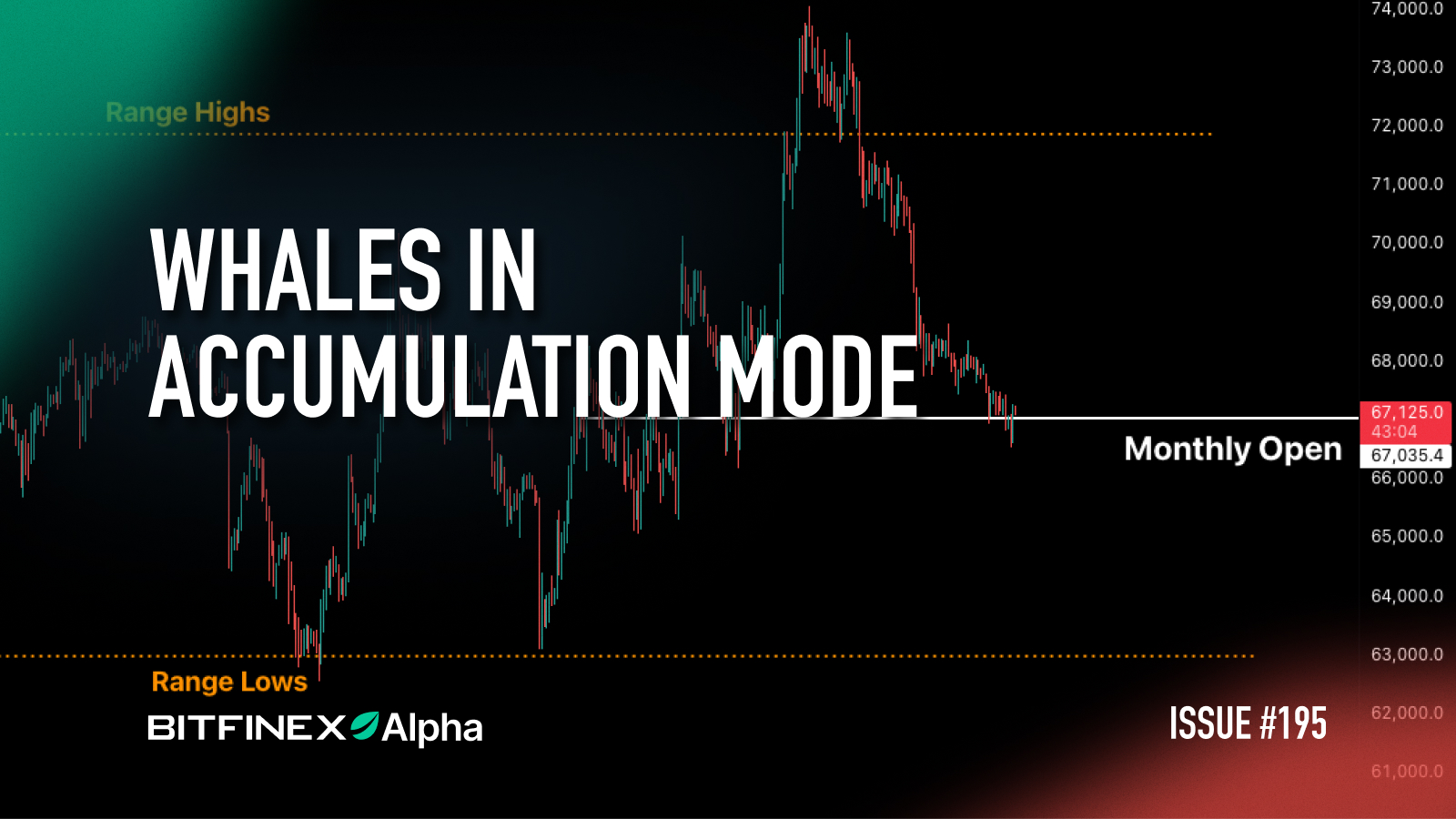
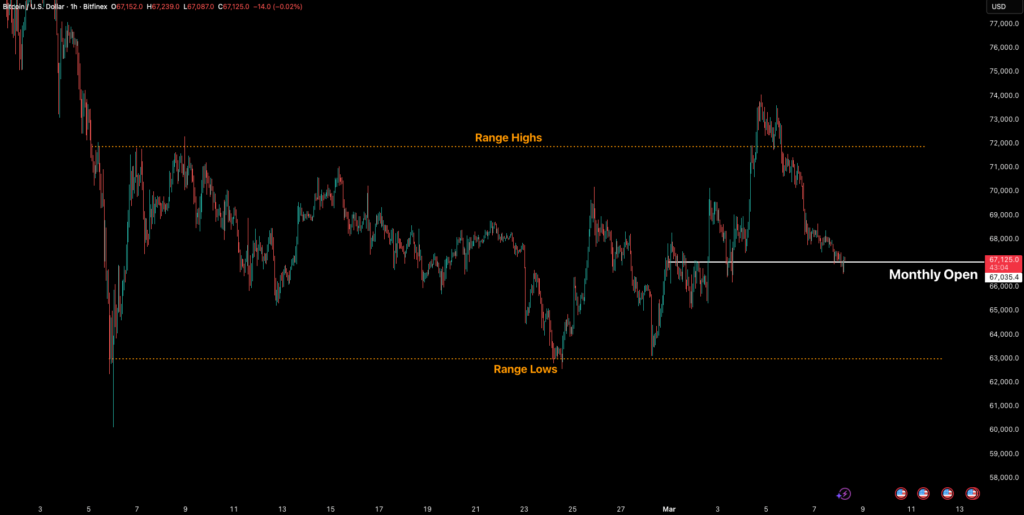
Bitcoin’s early March rally lost momentum with a brief break to $74,047, before reversing and sending price back toward the monthly open near $67,000. The move underscores how firmly the $62,500–$72,000 range continues to define market structure following February’s capitulation.
On-chain and order-flow data suggest the market is stabilising rather than deteriorating. Realised losses have compressed sharply since the February crash, indicating that forced selling has largely subsided, while spot CVD shows aggressive buying early in the month that has since been absorbed by passive supply near range highs. Meanwhile, accumulation remains concentrated among whales and long-term holders, even as retail investors continue to distribute. The result is a market in equilibrium. Downside pressure has faded, but without sustained ETF inflows or stronger spot demand, Bitcoin remains trapped in consolidation until the $72,000 resistance zone is decisively cleared.
The US economy is entering a period of increasing macroeconomic crosscurrents, as signs of cooling domestic activity coincide with renewed inflation risks driven by geopolitical tensions and rising energy prices.
Recent labour market data point to weakening employment conditions. The February Employment Situation Report from the Bureau of Labour Statistics showed that employers cut 92,000 jobs while the unemployment rate rose to 4.4 percent. Payroll estimates for the previous two months were also revised down by 69,000 jobs, suggesting labour demand had been weaker than initially reported. Consumer activity is also beginning to show early signs of moderation. Retail and food-services sales fell 0.2 percent month-over-month in January to $733.5 billion, although spending remained 3.2 percent higher compared with a year earlier. The slowdown has not been uniform across sectors.
At the same time, geopolitical tensions are raising new inflation risks through energy markets. The escalating conflict involving the United States and Iran has pushed oil prices higher, with West Texas Intermediate crude rising by roughly $20 per barrel. Higher energy costs tend to feed through into transportation, manufacturing and logistics expenses, creating inflationary pressure while also weighing on economic activity.
Although the US is more resilient to energy shocks than in previous decades, due to its large domestic energy production, rising fuel prices still increase household costs and can weigh on discretionary spending. These dynamics create a difficult policy environment for the Federal Reserve. While softer labour market conditions could support the case for interest rate cuts, the possibility that energy-driven inflation could reaccelerate may limit the central bank’s ability to ease policy in the near term.
Against this uncertain macroeconomic backdrop, developments within the cryptocurrency sector continue to reflect the growing integration of digital assets into institutional balance sheets and financial markets.
Strategy (formerly MicroStrategy) recently expanded its Bitcoin treasury strategy, acquiring an additional 3,015 bitcoins for approximately $204.1m at an average price of $67,700 per BTC. The purchase increased the company’s total holdings to 720,737 BTC, reinforcing its position as the largest corporate holder of Bitcoin globally.
While some firms are expanding their digital asset holdings, others are adopting more flexible treasury strategies. MARA Holdings, one of the largest publicly traded Bitcoin mining companies, has updated its digital-asset policy to allow the sale of Bitcoin from its existing reserves.
Regulatory developments also remain an important factor for the industry. The US Securities and Exchange Commission recently reached a settlement with crypto entrepreneur Justin Sun related to allegations involving the Tron ecosystem. Under the agreement, Rainberry Inc., a company associated with the Tron network and the BitTorrent protocol, will pay a $10 m civil penalty while the SEC dismisses its claims against Sun and related entities pending court approval.
Market Signals
Failed Breakout for Bitcoin
March began with a significant initial drive higher for Bitcoin, moving up 10.5 percent in the first four trading days. However, despite this initial momentum, BTC remains confined to its established range of $62,500 to $72,000, with the high of $74,047 reached on March 4th, proving to be a failed breakout.
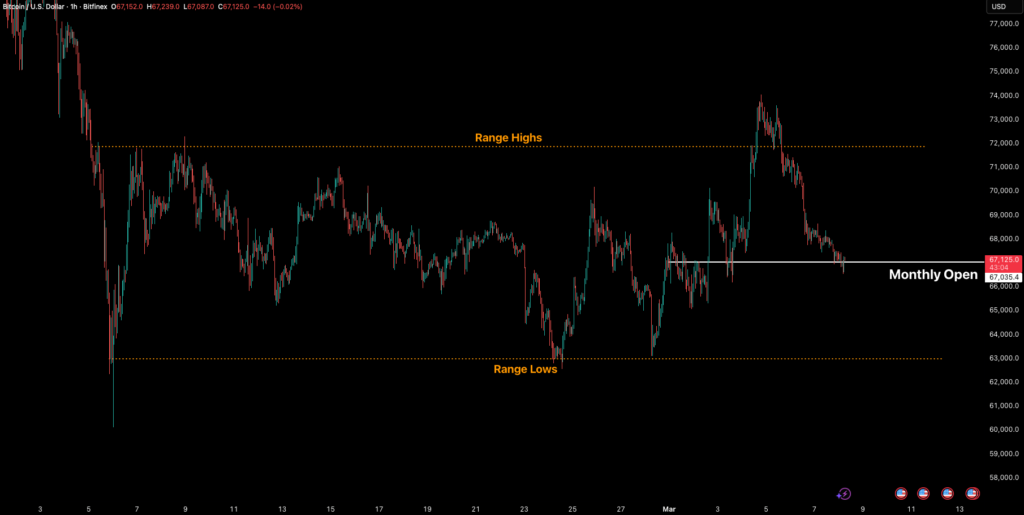
Figure 1: BTC/USD Hourly Chart. (Source: Bitfinex)
The Key Drivers for this Retracement Are:
- A reversal of the early-month ETF inflows.
- A relatively large amount of leveraged longs that has built late into the initial 10.5 percent move up, being liquidated.
Following a three-session expansion in BTC ETF flows in late February totalling $1.14 billion, BTC has encountered significant resistance. The March 5 and 6 sessions recorded a combined outflow of $576.8 million.
ETF flows have been a critical factor for price discovery, with IBIT trading volumes alone surpassing $100m/day consistently, and on occasion matching up to daily trading volumes of the top 10 Bitcoin spot trading pairs on conventional exchanges. While it is true that the first few trading sessions of every month usually see large inflows, due to systemic regular investments and fund rebalancing, the size of the reversal seen this month so far suggests, this might not be a regime change for ETF flows, yet.
Spot anchor block
It also indicates that the institutional bid is not price-insensitive, and that early month inflows don’t persist indefinitely. Traders should watch flows this week to see whether this is a reversal or just a bump in the road. Especially in case of any positive developments in the geopolitical situation.
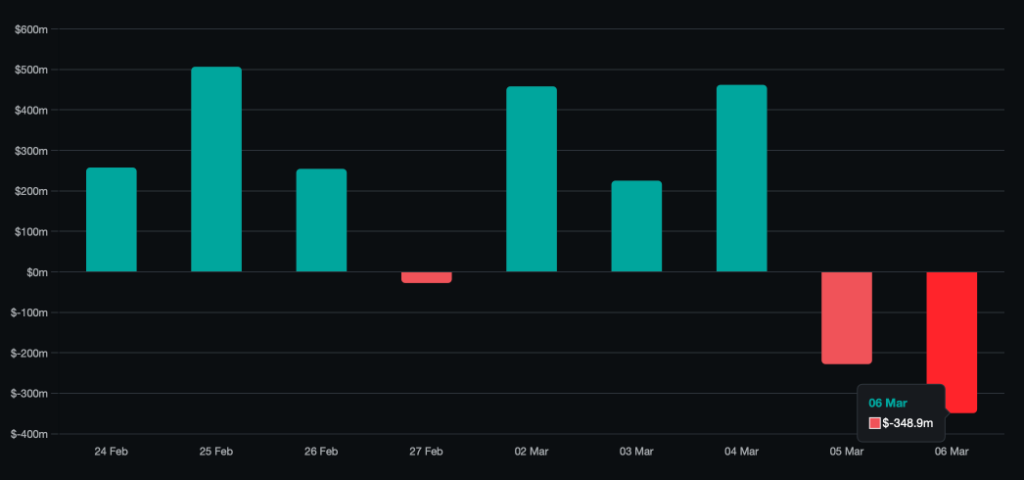
Figure 2: Aggregated Spot Bitcoin ETF Flows Across All US Providers.
(Data Source: FarsideUK)
Since establishing our current low of $60,100 on February 5, BTC has consistently failed to breach the range high near $72,000, despite multiple rapid upward price movements. This repeated rejection affirms the $72,000 region as a significant near-term resistance level.
Realised Profit
To ascertain if this price resistance reflects a fundamental degradation in demand, we have analysed the Realised Profit metric. This on-chain indicator aggregates the total USD-denominated profit; calculated as the sum of net profits from all transactions over a period, locked in by market participants.
General Macro Update
US Labour Market Weakens as Hiring Declines While Consumer Spending Shows Early Signs of Slowdown
The US economy is entering a period of increasing macroeconomic crosscurrents, as slowing job growth and early signs of softer consumer spending coincide with renewed inflation risks driven by rising energy prices and escalating geopolitical tensions in the Middle East.
The recent escalation in conflict involving the United States and Iran has pushed global oil prices sharply higher, raising concerns that energy costs could reignite inflation pressures even as parts of the domestic economy begin to cool.
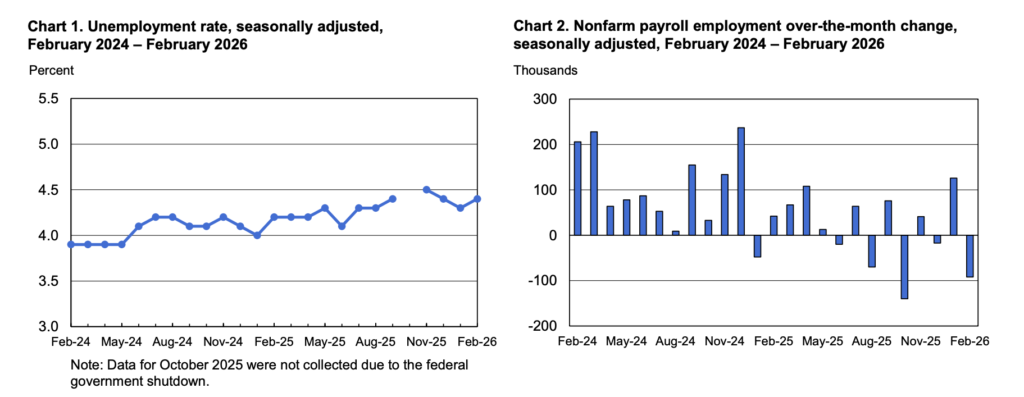
Figure 6. Unemployment Rate, Nonfarm Payroll employment
(Source: Bureau of Labour Statistics)
The February Employment Situation Report, released by the Bureau of Labour Statistics (BLS) last Friday, March 6, showed that US employers cut 92,000 jobs during the month and the unemployment rate increased to 4.4 percent. The data also included a 69,000 downward revision to employment figures for the previous two months, signalling that the labour market has been weaker than earlier estimates suggested.
Job losses were concentrated in several key industries. Manufacturing, construction, and other goods-producing sectors all reported declines, indicating persistent weakness in sectors sensitive to policy and trade conditions. Construction employment fell by 11,000 positions, manufacturing declined by 12,000, and goods-producing industries collectively shed 25,000 jobs. Federal government employment also decreased by 10,000 roles.
The February Employment Situation Report, released by the Bureau of Labour Statistics (BLS) last Friday, March 6, showed that US employers cut 92,000 jobs during the month and the unemployment rate increased to 4.4 percent. The data also included a 69,000 downward revision to employment figures for the previous two months, signalling that the labour market has been weaker than earlier estimates suggested.
Job losses were concentrated in several key industries. Manufacturing, construction, and other goods-producing sectors all reported declines, indicating persistent weakness in sectors sensitive to policy and trade conditions. Construction employment fell by 11,000 positions, manufacturing declined by 12,000, and goods-producing industries collectively shed 25,000 jobs. Federal government employment also decreased by 10,000 roles.
US-Iran Conflict Raises Energy Market Risks While Global Economy Faces Supply Chain Pressure
The escalating conflict between the United States and Iran has begun to affect global energy markets and trade routes, raising concerns about higher shipping costs and energy prices. However, the size and resilience of the US economy suggest it may absorb energy shocks more effectively than many other countries, even as global inflationary pressures increase.
The conflict began on February 28, 2026, when the US and Israel launched airstrikes against Iran, resulting in the death of Iran’s Supreme Leader Ayatollah Ali Khamenei and several government and military leaders. The war remains ongoing, and the economic consequences of the conflict will be closely tied to its duration. One of the most immediate risks comes from the Strait of Hormuz, a strategic maritime passage for oil and gas shipments. Although the waterway has not been fully closed (in a formal, legal sense, as of March 9 2026), shipping companies have started to avoid the route due to security concerns. As a result, insurance costs, freight rates and delivery times have risen. These disruptions can delay shipments and create logistical bottlenecks similar to those experienced during the COVID-19 pandemic.
Qatar has emerged as a critical factor in the unfolding energy disruption. A drone strike linked to Iran forced the closure of the world’s largest liquefied natural gas (LNG) export hub in the country, amplifying the supply shock. Qatar accounts for roughly 19 percent of global LNG exports, with a large share flowing to Asian markets. Several major economies rely heavily on these shipments. The United Kingdom imports roughly 50-60 percent of its natural gas, with a significant portion coming from Qatar, while Italy receives approximately 40-45 percent of its LNG from the country. Higher LNG prices are likely to feed into electricity costs and inflation in economies where natural gas is widely used for power generation.
Despite these risks, the US is generally considered more resilient to energy shocks than in previous decades due to structural changes in its energy sector. The US is now one of the world’s largest producers of crude oil and natural gas, which has reduced its dependence on imported energy and increased its ability to absorb global supply disruptions.Nevertheless, higher oil prices still act as a negative supply shock for the economy. Federal Reserve research shows that increases in oil prices tend to raise inflation while simultaneously weighing on economic activity, as higher energy costs raise transportation and production expenses across a wide range of industries. Macroeconomic estimates commonly used in policy analysis suggest that a sustained $10 increase in oil prices can raise inflation by roughly 0.4 percentage points while reducing economic growth by a similar magnitude.
Higher crude prices also pass through relatively quickly to consumer fuel costs. According to the US Energy Information Administration (EIA), gasoline prices typically increase by about 2.4 cents per gallon for every $1 rise in the price of crude oil. As a result, a sustained increase in oil prices could push gasoline prices significantly higher, raising household expenses and potentially weighing on discretionary consumer spending.
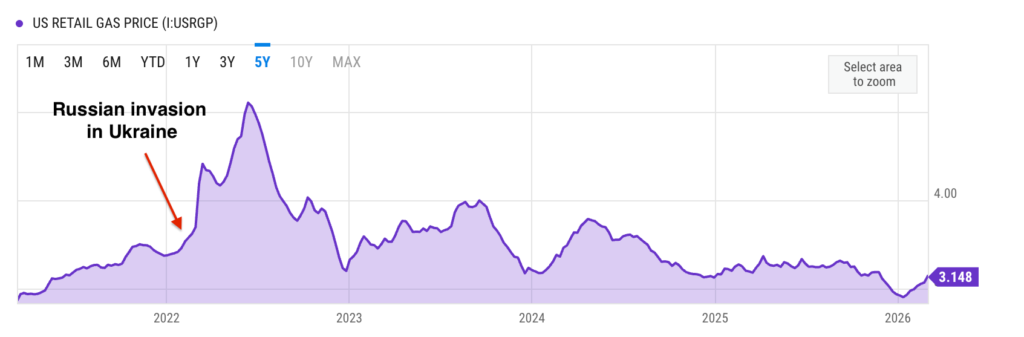
Figure 10. Gasoline Retail Price Since 2022 (Source: YCharts)
For comparison, gasoline prices reached a national average of $5.01 per gallon in June 2022 following Russia’s invasion of Ukraine. That surge led many households to reduce spending, demonstrating how energy costs can influence consumer behaviour. Currently, US gasoline prices are near $3.10 per gallon, well below the level that typically begins to constrain broader economic activity. Nevertheless, some sectors are more sensitive to energy costs. Industries such as agriculture, manufacturing, mining and chemicals are likely to pass higher energy expenses on to consumers through increased prices.
News from the Cryptosphere
Strategy Expands Bitcoin Treasury With $204M Purchase, Holdings Reach 720,737 BTC

Strategy (formerly MicroStrategy) announced that it had acquired 3,015 additional bitcoins as part of its ongoing corporate treasury strategy centred on Bitcoin. The purchase, disclosed in a Form 8-K filing submitted to the U.S. Securities and Exchange Commission, was executed between February 23 and March 1, 2026, and cost approximately $204.1 m, with an average purchase price of $67,700 per BTC.
Following the transaction, Strategy’s total bitcoin holdings increased to 720,737 BTC, solidifying its position as the largest corporate holder of bitcoin globally. These holdings were accumulated at a total acquisition cost of about $54.77 bn, corresponding to an average purchase price of roughly $75,985 per bitcoin.
The latest purchase was financed through the company’s at-the-market (ATM) equity issuance programs. Strategy raised funds primarily by selling Class A common shares (MSTR) and Variable Rate Series A perpetual preferred shares (STRC). Specifically, the company sold approximately 1.73 m MSTR shares, generating about $229.9 m, and issued additional preferred shares that produced around $7.1 m in proceeds. This capital was then deployed to expand its bitcoin treasury while retaining some liquidity.
This acquisition is part of Strategy’s broader strategy of systematically converting capital raised from equity markets into bitcoin, effectively transforming the company into a leveraged corporate vehicle for bitcoin exposure. The approach reflects the long-standing thesis championed by executive chairman Michael Saylor, who views bitcoin as a superior long-term reserve asset compared with traditional cash reserves.
However, the aggressive accumulation strategy has also introduced significant financial volatility. Because the company now applies fair-value accounting to its digital assets, fluctuations in bitcoin prices directly affect reported earnings. As a result, the firm’s financial performance is closely tied to cryptocurrency market movements, with unrealised gains or losses significantly influencing quarterly results.
SEC and Justin Sun Reach Settlement in Tron Fraud Case

The US Securities and Exchange Commission (SEC) has reached a settlement with crypto entrepreneur Justin Sun, resolving a high-profile lawsuit tied to the TRON (TRX) ecosystem. Under the agreement, Rainberry Inc., a company associated with the Tron network and the BitTorrent protocol, will pay a $10 m civil penalty, while the SEC will dismiss its claims against Sun and related entities pending court approval.
The settlement brings an end to litigation that began in March 2023, when the SEC sued Sun and several affiliated organisations, including the Tron Foundation and BitTorrent Foundation, for alleged violations of US securities laws. Regulators accused Sun of orchestrating unregistered securities offerings involving the Tron (TRX) and BitTorrent (BTT) tokens, as well as conducting wash trading schemes designed to artificially inflate trading volumes in the secondary market.
According to the SEC’s original complaint, Sun allegedly directed employees to execute hundreds of thousands of transactions between accounts he controlled, creating the appearance of legitimate market demand and liquidity for TRX. The regulator also claimed that Sun paid celebrities, including figures such as Lindsay Lohan and Jake Paul, to promote Tron-related tokens on social media without properly disclosing that the endorsements were sponsored.
Under the terms of the settlement, Rainberry will be barred for violating certain securities regulations and must pay the $10 m fine, while all claims against Sun, the Tron Foundation, and the BitTorrent Foundation will be dismissed with prejudice, meaning the SEC cannot bring the same allegations again. The defendants did not admit or deny wrongdoing, a common condition in US regulatory settlements.
The resolution reflects a broader shift in the US regulatory environment toward cryptocurrencies. Several enforcement actions launched during the tenure of former SEC chair Gary Gensler have been paused or resolved as policymakers reassess the government’s approach to digital-asset oversight.
MARA Signals Shift from “HODL” Strategy by Allowing Sales of Bitcoin Reserves
MARA Holdings, one of the largest publicly traded Bitcoin mining companies, has revised its digital-asset management strategy to allow the potential sale of Bitcoin held on its balance sheet. The policy change marks a notable shift from the firm’s earlier “HODL” approach, in which it primarily accumulated and retained mined Bitcoin as a long-term treasury asset.
The update was disclosed in the company’s 2026 strategy and SEC filings, which expanded earlier rules that only permitted selling newly mined bitcoin. Under the revised framework, MARA can now sell portions of its existing treasury reserves, providing management with greater flexibility to respond to market conditions or liquidity needs.
As of December 31, 2025, the company held approximately 53,822 BTC, worth about $4.7 bn at the time. A portion of these holdings is already actively deployed through financial strategies: roughly 9,377 BTC have been lent to counterparties, while 5,938 BTC are pledged as collateral for credit facilities totaling about $350 m.
The strategic shift reflects financial pressures and volatility in the crypto mining industry. During 2025, MARA reported a $422.2 m decline in the fair value of its bitcoin holdings, highlighting the impact of price fluctuations on its balance sheet. At the same time, mining output dropped 7 percent year-over-year, partly due to increased network difficulty and the 2024 Bitcoin halving, which reduced block rewards for miners.
Although the company now has the option to sell bitcoin, the policy does not require liquidation. Instead, MARA stated it may buy or sell BTC “from time to time” depending on capital allocation priorities, operating costs, and prevailing market conditions. The company still expects its Bitcoin holdings to generally grow over time through mining and occasional purchases.
Overall, the new policy reflects a broader transformation in MARA’s financial strategy. Rather than simply accumulating Bitcoin as a passive treasury asset, the company is moving toward a more active balance-sheet management model, where its multibillion-dollar Bitcoin reserve can be used strategically to support liquidity, operations, and long-term growth initiatives.
Existing Safeguards Deemed Insufficient
Minnesota introduced regulatory measures in 2024 to address fraud risks linked to cryptocurrency kiosks. These rules required operators to:
- display warnings that virtual currency is not legal tender
- inform customers that transactions are irreversible
- clarify that fraud-related losses are generally unrecoverable
The law also imposed a $2,000 daily transaction limit for new customers, defined as those with accounts less than 72 hours old, and required full refunds for fraudulently induced transactions if customers contacted both the operator and law enforcement within 14 days.
Despite these measures, state officials said fraud persists. The Department of Commerce stated that earlier consumer protection efforts have not delivered sufficient results. HF 3642 would therefore repeal the current framework rather than amend it.
Importantly, the proposed ban applies only to physical kiosks. Residents would still be able to purchase or transfer digital assets online.
While regulators initially sought to mitigate risk through transaction limits and mandatory disclosures, lawmakers now appear prepared to remove the machines entirely from the state.
The debate highlights a broader policy shift: regulators are increasingly distinguishing between online digital asset access and physical cash-to-crypto infrastructure, which they view as more susceptible to exploitation.